Petrol Drops, Diesel Surges: What August's Fuel Split Means for You
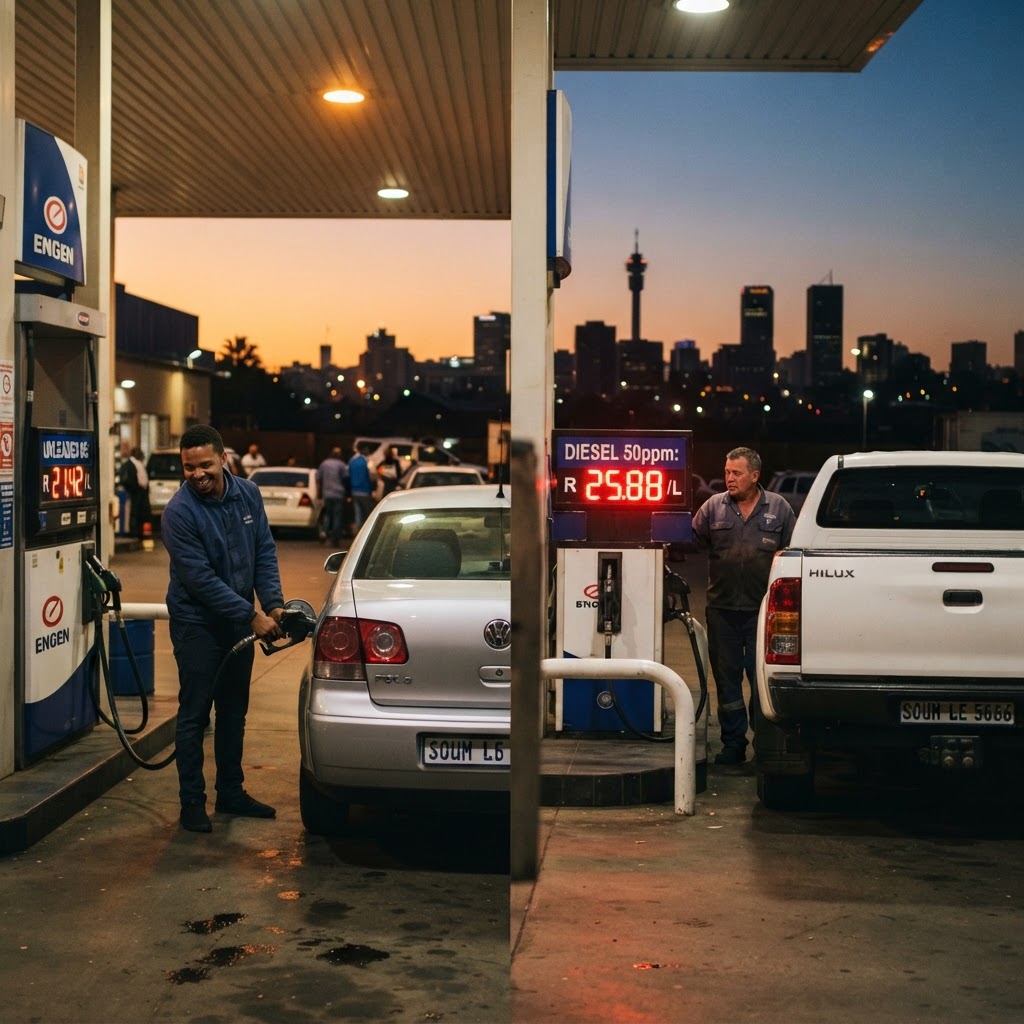
From Wednesday, 5 August 2026, South African motorists face an unusual split at the pumps: petrol prices are dropping while diesel and paraffin costs climb sharply. Both 93 and 95 octane petrol fall by 52 cents per litre, offering welcome relief to most private car owners. But diesel users are not so lucky — 500ppm diesel rises by R1.23 per litre and 50ppm diesel by R1.38 per litre, with paraffin also jumping over a rand in most regions.
The split stems from a mix of global and local pressures. Middle East tensions pushed Brent crude briefly above $100 a barrel before it settled near $83, while the Rand weakened slightly against the Dollar. Petrol was shielded from the worst of this thanks to a government reduction in the Slate Levy, from R1.13 to 61 cents per litre — a policy move that effectively absorbed what would otherwise have been a petrol price hike. Diesel received no such cushioning, leaving it fully exposed to international price pressure.
This matters because diesel isn't just a fuel choice — it's the backbone of South Africa's freight, farming, and public transport sectors. Economists warn the increase will ripple through to food prices, taxi fares, and delivery costs well before most consumers notice it at the pump directly. For diesel bakkie and SUV owners, though, the pain is immediate and personal.
DriveLedger's view: this is not a one-off anomaly but a signal of a structural pricing divide opening up between petrol and diesel motoring costs in South Africa — one that should influence your next vehicle purchase decision, not just this month's budget.
What Happened
On 3 August 2026, the Department of Mineral and Petroleum Resources announced that petrol prices would fall by 52 cents per litre for both 93 and 95 octane grades from 5 August, while diesel and paraffin prices would rise steeply. 500ppm diesel increases by R1.23 per litre and 50ppm diesel by R1.38 per litre, with paraffin rising R1.01 to R1.38 per litre depending on region.
The cause is twofold: international oil price volatility driven by US-Iran tensions (Brent crude spiked above $100 a barrel before settling near $83), and a weaker Rand averaging R16.45 to the Dollar. Petrol was largely protected from these pressures because government cut the Slate Levy from R1.13 to 61 cents per litre — a 52-cent reduction that offset the international cost pressure petrol would otherwise have faced. Diesel had no equivalent buffer, so it absorbed the full brunt of global pricing.
After the adjustment, inland 95 Unleaded costs R26.17/litre and coastal R25.30/litre; inland 93 Unleaded is R25.42/litre. Diesel inland 50ppm is now R26.39/litre and 500ppm R26.16/litre, with coastal prices at R25.64 and R25.29 respectively.
Why It Matters
For the roughly 80% of private motorists who run on petrol, this is genuinely good news — a small but real saving on every tank. But the other 20% who drive diesel vehicles, plus virtually the entire logistics, farming, and construction sectors, are facing a meaningful cost increase that won't stay isolated to fuel budgets.
Diesel price hikes tend to flow into the price of almost everything else — groceries, bus and taxi fares, building materials — because trucks and tractors run on diesel, not petrol. Industry voices like MISA and Econometrix have flagged that lower-income households, who spend a larger share of income on food and transport, will feel this increase indirectly and disproportionately, even if they don't own a diesel vehicle themselves.
For diesel bakkie, SUV, and light commercial vehicle owners specifically, this is a direct hit to running costs that arrives without warning and compounds over multiple fill-ups a month.
Who Is Affected
All South African motorists are affected by this price adjustment, but the impact is uneven. Diesel vehicle owners — including popular bakkies like the Toyota Hilux, Ford Ranger, Isuzu D-Max, and diesel-powered SUVs and sedans — face the sharpest direct cost increase. Fleet operators, delivery and logistics companies, farmers, and public transport operators relying on diesel-powered trucks and buses will see operating costs rise immediately.
Petrol vehicle owners, who make up the majority of private car owners in South Africa, benefit modestly from the 52c/litre reduction. Households relying on paraffin for heating or cooking, particularly in lower-income and rural areas, will also feel the paraffin price increase directly.
What You Should Do
If you drive a petrol vehicle, there's little action required beyond enjoying the modest saving — though it's worth reviewing your monthly fuel budget to reflect the small drop. If you drive a diesel vehicle, now is the time to tighten fuel efficiency habits: reduce unnecessary idling, keep tyres properly inflated, remove excess weight, and consider consolidating trips.
Fleet operators and small business owners using diesel vehicles should revisit pricing models and delivery charges now, rather than absorbing the increase silently for months. If you're planning a vehicle purchase in the near term, factor this fuel price divergence into your decision — particularly if you're comparing petrol versus diesel versions of the same model.
Households using paraffin should budget for the increase immediately, as it takes effect from 5 August with no phase-in period.
DriveLedger Insight
DriveLedger's read on this: the growing gap between petrol and diesel pricing isn't just a monthly fluctuation — it reflects a structural policy choice to cushion petrol (which affects more voters and consumers directly) while leaving diesel exposed to global markets. Over successive cycles, this could meaningfully shift the total cost of ownership calculus for diesel vehicles in South Africa, especially for bakkie owners who chose diesel primarily for fuel efficiency on long distances.
Owners of diesel vehicles should start tracking their actual cost-per-kilometre more closely rather than assuming diesel's traditional efficiency advantage will always outweigh its now-volatile price premium. This split is a useful early warning for anyone due to replace a diesel vehicle in the next 12-24 months.
Action Checklist
- Petrol owners: note the 52c/litre saving in your August budget, no other action needed
- Diesel owners: recalculate your monthly fuel cost using the new R26.16-R26.39/litre inland rates
- Fleet and business owners: update delivery or service pricing to reflect higher diesel input costs
- Reduce diesel consumption where possible — check tyre pressure, remove excess cargo weight, avoid idling
- Households using paraffin: adjust monthly budgets for the R1.01-R1.38/litre increase from 5 August
- If buying a new vehicle soon, compare total fuel cost of diesel vs petrol variants over your expected ownership period
- Track your vehicle's actual litres-per-100km to measure real-world impact of the diesel price hike