August 2026 Fuel Prices: Petrol Falls, Diesel Spikes Sharply
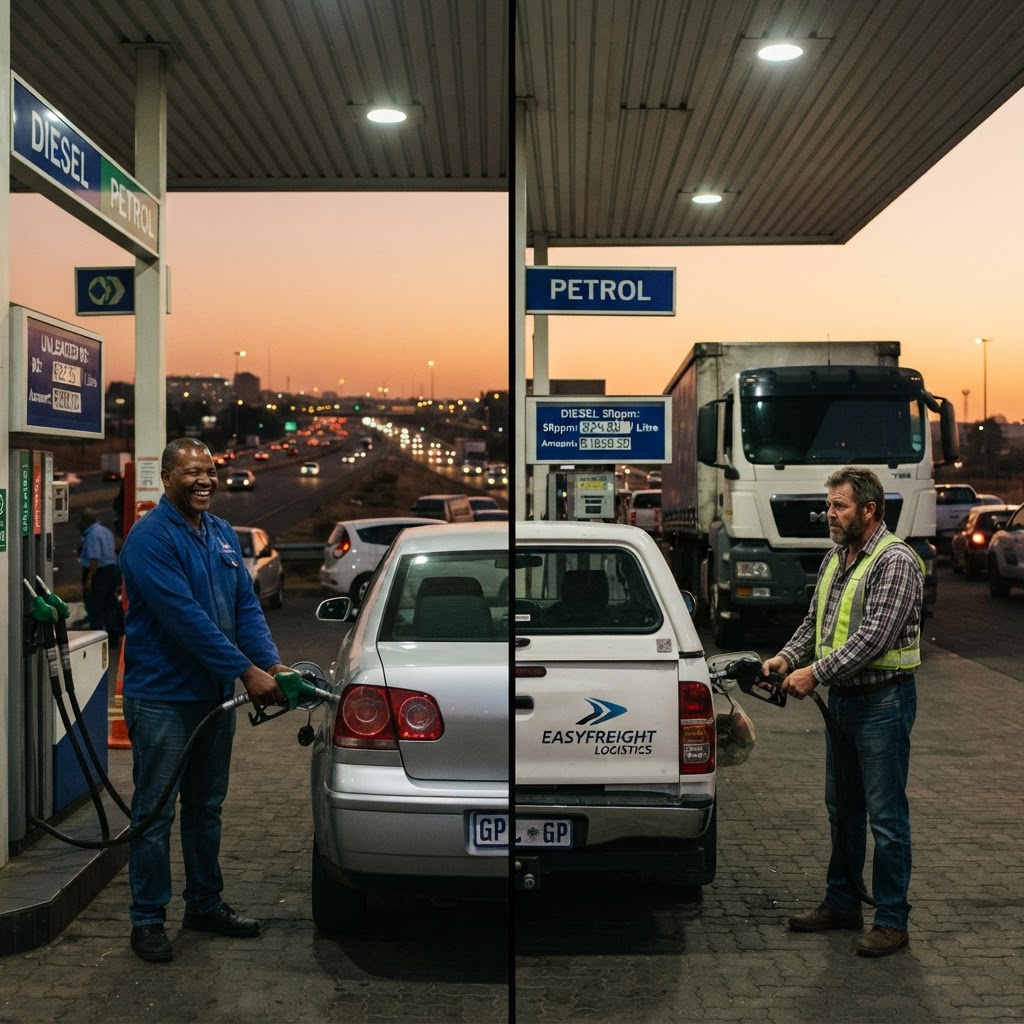
From Wednesday, 5 August 2026, South African motorists face a split fuel story. Petrol motorists get a small break — both 93 and 95 octane drop by 52 cents per litre — while diesel users are hit hard, with 500ppm diesel rising R1.38 per litre and 50ppm diesel up R1.23 per litre. This is not a random fluctuation. It stems directly from a collapsed ceasefire between the US and Iran in mid-July, which triggered military strikes and a US attempt to control the Strait of Hormuz, one of the world's most important oil shipping routes.
Even though the average Brent Crude price actually fell during the review period (from $86.53 to $82.37 per barrel), that good news was wiped out for diesel because international product markets — separate from crude itself — reacted violently to the Middle East escalation. A weaker rand added further pressure, contributing roughly 6.37c/litre to petrol costs and 8.14c/litre to diesel costs. Illuminating paraffin, a lifeline fuel for many low-income households, jumped R1.52 per litre — arguably the most socially painful number in this entire update.
The result: Gauteng motorists will pay R25.42/litre for 93 Unleaded and R25.58/litre for 95 Unleaded, while wholesale diesel sits at R26.16/litre (500ppm) and R26.40/litre (50ppm). For everyday petrol-driven households, this is modest relief. For businesses running diesel fleets — logistics, farming, construction, mining — this is a real cost shock that will likely filter into food prices, delivery fees, and transport costs within weeks.
Underlying all of this is South Africa's fuel price mechanism itself: the slate levy system, currently recovering a R7.418 billion deficit accumulated by end-June 2026. This structural debt means South African fuel prices remain sensitive to both global shocks and domestic recovery mechanisms — a double exposure most consumers don't realise they're carrying every time they fill up.
What Happened
The Department of Mineral Resources and Energy confirmed that from 5 August 2026, petrol prices (93 and 95 octane) drop by 52 cents per litre nationally, while diesel prices rise sharply — R1.38/litre for 500ppm diesel and R1.23/litre for 50ppm diesel. Illuminating paraffin rose R1.52/litre, while LP gas dropped R4.41/kg nationally (R5.03/kg in the Western Cape).
The divergence traces back to a fragile 60-day US-Iran ceasefire that collapsed after military strikes on 13-14 July 2026, followed by a US move to assert control over the Strait of Hormuz — a chokepoint through which a huge share of the world's oil and refined product supply passes. This geopolitical shock pushed up international diesel and paraffin prices even while crude oil itself was trending downward, because diesel markets responded independently to supply-security fears.
A weaker rand compounded the diesel increase specifically, adding over 8c/litre versus roughly 6.4c/litre on petrol. The DMRE also confirmed the fuel price recovery slate remains R7.418 billion in deficit as of end-June 2026, meaning a slate levy continues to be applied to claw back prior under-recoveries — a structural factor separate from global oil markets but embedded in every litre South Africans buy.
Why It Matters
For private petrol car owners, this is a rare, welcome — if small — reduction. But the diesel increase matters far more broadly than most petrol-driven households realise. Diesel underpins freight trucking, agriculture, mining, construction, and much of South Africa's food supply chain. When diesel spikes over R1/litre in one month, transport operators pass that cost through to retailers, and retailers pass it through to consumers — meaning grocery and goods prices could drift upward over the following weeks even for households that never buy diesel directly.
The illuminating paraffin increase is the most concerning line item from a social equity view: it directly raises heating and cooking costs for lower-income households who rely on paraffin as their primary energy source, at a time when petrol relief benefits car-owning households disproportionately.
This split pricing also reveals how exposed South Africa remains to distant geopolitical events. A ceasefire collapse thousands of kilometres away, tied to a shipping corridor most South Africans have never heard of, can materially change what a Joburg contractor pays to run a bakkie fleet or what a Free State farmer pays to run harvesting equipment.
Who Is Affected
Diesel-dependent businesses are the biggest losers this month: logistics and freight operators, farmers, construction firms, mining operations, and any fleet running bakkies, trucks, or generators on diesel. Owners of diesel double-cab bakkies (Hilux, Ranger, Amarok, D-Max and similar) and diesel SUVs will feel this at every fill-up.
Petrol car owners nationwide — from Polo and Corolla drivers to premium SUV owners — get modest relief, though 52c/litre is unlikely to be noticeable against a full tank.
Low-income households using paraffin for cooking and heating are disproportionately affected by the R1.52/litre paraffin increase, while households using LP gas (particularly in the Western Cape) get meaningful relief from the price drop.
What You Should Do
If you drive a diesel vehicle, budget for the increase now rather than being surprised at the pump — recalculate your monthly fuel spend using the new wholesale figures (R26.16-R26.40/litre) and adjust household or business budgets accordingly. If you run a business with a diesel fleet, review pricing and client contracts this month, since freight and delivery cost increases are likely to be passed through the supply chain regardless of your own margins.
Petrol drivers should still practise normal cost discipline — the 52c/litre saving is welcome but marginal, and won't offset broader cost-of-living pressure from the diesel-driven inflation ripple. Log your fuel costs in a tracking tool so you can see the real month-on-month trend rather than reacting to headlines.
Households using paraffin should look into whether LP gas is a viable and cheaper alternative this month, given the price drop, especially in the Western Cape where the reduction is largest.
DriveLedger Insight
DriveLedger's view: this month's price split is a preview of a structural risk South African vehicle owners will face more often — global crude prices and local pump prices are decoupling. Historically, motorists watched Brent Crude as their main pricing signal. But this month proves that refined product markets (especially diesel) can move independently and violently based on shipping-route risk, even while crude itself falls. Owners who only track Brent Crude headlines will be blindsided by diesel spikes like this one.
Our recommendation: diesel vehicle owners and fleet managers should start tracking Strait of Hormuz and Middle East shipping risk directly, not just oil price benchmarks, since this corridor's stability is now a more accurate early warning signal for diesel price direction than crude oil alone.
Action Checklist
- Recalculate your monthly diesel or petrol spend using the new per-litre prices effective 5 August 2026
- Diesel vehicle owners: build a buffer into your budget for continued volatility linked to Middle East shipping risk
- Fleet operators: review client pricing and delivery contracts to account for the R1.23-R1.38/litre diesel increase
- Log your actual fuel costs in DriveLedger to track true month-on-month spend versus headline price changes
- Paraffin-using households: compare current LP gas pricing in your area as a potential cost-saving alternative
- Petrol drivers: bank the small 52c/litre saving rather than adjusting driving habits, as the impact per tank is marginal
- Keep an eye on Strait of Hormuz developments — further escalation could mean additional diesel price shocks next month